


China's first open, system-level account of its own fundamental research was launched in Beijing this morning. James Wilsdon, who co-chaired its international review committee, explains why the report matters, how it has landed, and what it asks of the rest of us.
Like many policy wonks, I tend to measure the passage of time in units of projects, reports, articles and the occasional book. Cut me open and, like a tree, I’m ringed by dozens of these increasingly quaint artefacts of efforts to translate ideas and evidence into change in policies or institutional practices. Some of them catch fire; others are damp squibs. Occasionally, you’re involved in one that feels like a game-changer.
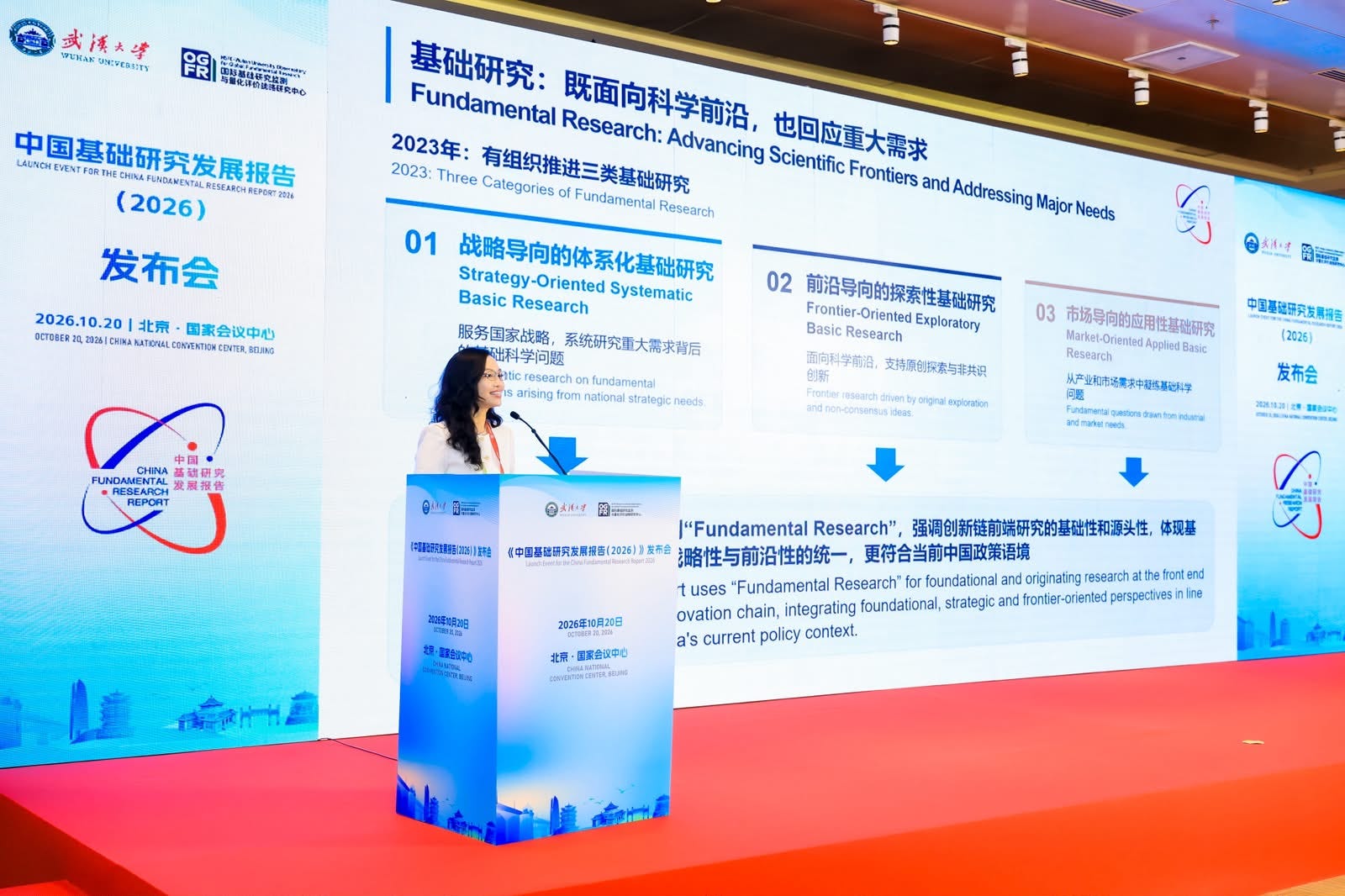
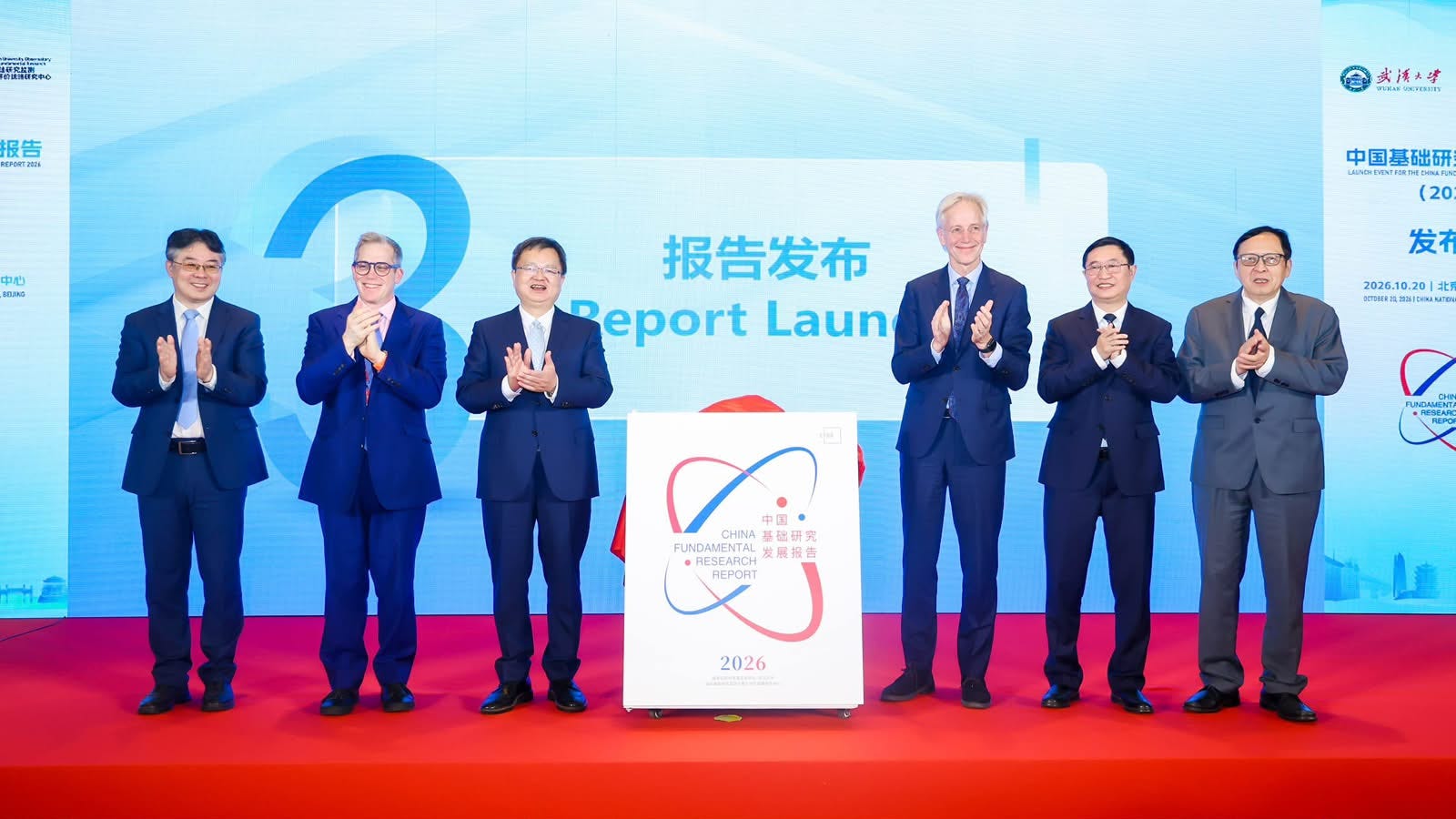
So it was this morning when I arrived at the China National Convention Center in Beijing for the launch of the China Fundamental Research Report (2026). In the room were the leadership of the National Natural Science Foundation of China (NSFC), which commissioned the report to mark its fortieth anniversary; Zhang Pingwen, the President of Wuhan University; Robbert Dijkgraaf, former science minister of the Netherlands, who takes over this week as President of the International Science Council; and others who inform and influence the direction of Chinese science and innovation policy. The launch took place alongside the ISC’s Beijing Science Dialogue, which has brought a slice of the global science policy community to China this week.
I have been coming to China to study its research system, on and off, for twenty-one years. My first report, China: the next science superpower?, written with James Keeley in 2007 for the think tank Demos, carried a question mark. We were trying then to understand the significance of the Medium and Long Term Plan (MLP) for 2006 to 2020, with its targets of raising R&D investment to 2.5 per cent of GDP and for China to become a world leader in science by mid-century.
Back then, many outside China were sceptical. Our conclusion was different: that the ambition of the MLP was serious; that more science in China need not mean less in Europe or America; and that the choice facing the rest of the world was not whether to engage with China’s research system, but how.
This morning, for me, the question mark came off for good. Yesterday’s headline about the report in Times Higher Education said that China had ‘played the long game’. I would put it slightly differently: China has kept a long promise. Four decades of continuity in support for fundamental research, through cycles in which others wavered. That continuity is the first lesson of this report, demonstrated with evidence rather than assertion – and at a time when support for these foundations is wavering in the United States and large parts of Europe.
Why does the CFRR matter?

What’s new and distinctive about the China Fundamental Research Report (CFRR)? I had the privilege of co-chairing its International Review Committee and would highlight four things:
First, this is a landmark study. The CFRR is the first system-level, openly documented account of how the fastest-growing node in global science funds, organises and evaluates itself. The report runs to 500 pages in Chinese and 250 pages in English; and is built almost entirely on open data (OpenAlex, CORDIS) and open methods, with an online platform through which its figures can be reproduced and challenged. It also makes available, for the first time, a tranche of NSFC’s internal funding data. It is, I think, the first Chinese report on Chinese science that invites the world to check its numbers. Within the metascience community, there is no higher form of respect.
Second, it marks a generational shift. Led by Lin Zhang and the NSFC–Wuhan University Observatory for Global Fundamental Research, with fourteen teams from nine universities, this process has foregrounded a new generation of Chinese scientometricians and metascientists: fluent in the international literature, at ease with its current debates, and now setting the global agenda for the measurement of science systems, rather than following it.
Third, it is candid about gaps as well as gains. China now produces around a third of the world’s fundamental research papers, up from under one per cent in 1985. But it spends 0.18 per cent of GDP on basic research, against 0.5 per cent in the United States; only around a fifth of its papers are internationally co-authored; and some 4.6 million Chinese-language articles sit outside the record on which this report, and every global indicator, relies. A report that tells you what it cannot see is one you are more likely to trust about what it can.
Fourth, and most important, it refuses to rank. There is no composite league table. Instead, the report asks a different and better question: what does a research system contribute, to knowledge, to capacity, and to the public good?
How has it landed?
How can the agenda which the CFRR sets be carried forward? In a World View for Nature this week, Lin Zhang lays out the ask: governments should make as much research information as possible openly available; researchers and governments need to agree what should be measured and how (starting with a shared definition of ‘fundamental research’, reproducible methods and comparable indicators); and the OECD, ISC, Global Research Council and Science Europe are ‘well placed to lead this work’. The data and methods behind the report are already live at cfrr.net.
In the room today, the responses were more striking coming from those with no stake in the report. Magdalena Skipper, Editor-in-Chief of Nature, said that what struck her was ‘how true it rings’, when set against her own 25 years of visiting Chinese laboratories, first as a geneticist, and then an editor. Her sharpest point was about AI. In an age of agentic tools that can generate results, she said, there is a danger of focusing disproportionately on more research, more productivity. What, she asked, does contribution even mean when AI agents make discoveries without crediting the work they ingest?
Robbert Dijkgraaf, speaking as he assumes the presidency of the ISC, made two arguments that deserve to be heard beyond the room. The first was about what a research system is for. The opportunities offered to young researchers, the openness of institutions, the recognition of different forms of scientific contribution, and a culture that welcomes criticism and unconventional ideas ‘are not secondary considerations; they are part of the foundations on which great science is built’. He welcomed the report’s deep dive into data on early-career support, research assessment, integrity and open science, because ‘the strength of a research system cannot be measured only by what it produces today, but by its capacity to discover what nobody can yet imagine’.
The second was about borders. Fundamental research is unlike almost any other investment: its discoveries are unexpected, its benefits take decades, and its impact rarely stops at a frontier. ‘Knowledge is the only resource that grows when it is shared.’ Of course, we should not be naive about competition, sovereignty and security, ‘but neither should we allow geopolitical competition to define the boundaries of scientific cooperation’. He welcomed the ambition to turn the report into an open international resource, with researchers in and outside China invited to help frame questions, develop the methods and interpret the results. And he concluded with a paradox: ‘Science is becoming more global at precisely the moment when the world is becoming more fragmented.’
Adding, or dilution?
Why does this report deserve our attention? Because the ground beneath all our research systems is moving, and the CFRR shines a light where that movement is most visible.
In 1945, Vannevar Bush placed one nation at the edge of an endless frontier. Eighty-one years later, the frontier may still be endless, but it has many outposts. The linear model of basic to applied research is creaking. And AI is adding to everything, everywhere, all at once: more proposals, more papers, more reviews, more data, more indicators.
In an essay published this week on Frontiers Policy Labs to coincide with the ISC’s Beijing meeting, I borrow a question from the English poet Philip Larkin: why do we assume that adding means increase? Sometimes it means dilution.
Adding will mean increase in science only if we have first decided what we value and what we want to count. That is precisely the decision the CFRR makes: to count contribution, not rank; to build comparability with others; and to treat openness as something reciprocal.
The CFRR also poses, in its gaps, three urgent questions which the governance structures of science – including the ISC – must now answer. Whose categories? An OECD-mandated vocabulary of science statistics no longer describes who does research, where and how. Who is visible? Those 4.6 million Chinese-language articles missing from global datasets are a stark illustration of how research-information infrastructures decide what a system can see and therefore what it rewards. And who decides? If the hidden chooser in assessment is increasingly a model trained on last year’s winners, then no funder, journal or university should deploy it without disclosing where, measuring its effects, and testing whether it identifies and augments what humans miss, or rewards more of the same.
An answering voice
Dijkgraaf’s paradox is the right framing, and his proposed measure a helpful yardstick: ‘not simply how much knowledge individual nations produce, but how much humanity as a whole can discover, understand and achieve’.
Some of yesterday’s coverage called the CFRR “a wake-up call for the West”. I understand such reactions. But I think the report is something more interesting: an invitation. One which deserves an answer.
On 3 November, RoRI will publish Seize the Meta-Moment!, an 18-country study of the changing shape of metascience worldwide, with Lin Zhang one of its co-authors. We classify China among ‘directed’ metascience systems whose strengths include standing institutions and long planning cycles. And our analysis shows how all systems now face the same hard problems: how to measure what matters; how to make evidence open and challengeable; and how to use AI to widen rather than narrow what we value. None can solve these alone. The measurement of science is a global public good, which needs a global community to build it.
The CFRR’s epilogue ends with the ancient Chinese line: “A bird calls out, seeking an answering voice.” I hope that in the months and years ahead there will be a chorus — from Beijing and Wuhan, to London, Brussels, Pretoria, Washington and beyond — of scholars, policymakers and funders who choose understanding over ranking, contribution over competition, and openness over suspicion.
And here’s one more immediate opportunity to add your voice to the mix! On Tuesday 27 October, from 14:00 to 16:00 UK time, RoRI and UCL will co-host with the NSFC–Wuhan University Observatory for Global Fundamental Research the first online international discussion of the report.
We’ll hear from Lin Zhang and two of her team, Yi Bu and Lele Kang, followed by questions, responses, and a discussion with Geraint Rees, Roger Pielke Jr, Heide Hackmann, Laura Ryan, Ludo Waltman, and Gunnar Sivertsen. Registration is free here. So come along and check the numbers. That, after all, is what the report asks.
James Wilsdon is Professor of Research Policy at UCL and Executive Director of the Research on Research Institute. He co-chaired the International Review Committee of the China Fundamental Research Report (2026) with Ludo Waltman. A related essay 'Does adding mean increase?', is published this week on Frontiers Policy Labs.

I would be particularly interested how China views the macroeconomics structure of social business systems as a whole.